
Easy short hikes around Banff and Canmore
Tunnel Mountain starts from a residential street in Banff, and that is typical of the valley, where several of the best short walks begin within a few minutes of town.
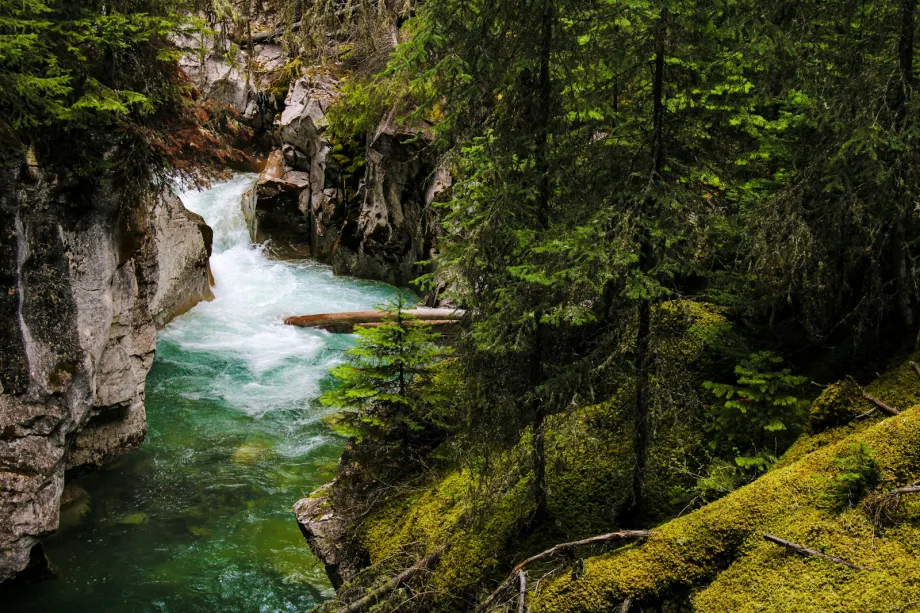
Banff lies on a broad valley floor ringed by steep peaks, so you do not need to climb a summit to get a big view or walk into deep forest. Two of the classic short walks start almost in town, and two more lie a short drive away.
Short trails near Banff townsite
Tunnel Mountain
Tunnel Mountain is the small, wooded peak right beside the townsite. The trail starts on St. Julien Road, near the Banff Centre, and climbs steadily on a well-kept path with long switchbacks. Most people reach the top in under an hour, and the round trip is a little under 5 kilometres.
The summit is a rocky, open ridge with views of Mount Rundle, the Bow River and the streets below. The slope faces south and west, so it dries out earlier in spring than shaded forest trails and can get dusty by midsummer. Light hiking shoes or sturdy runners are enough. Children who are fine with a steady uphill walk usually manage it well.
Fenland Trail
The Fenland Trail is a flat loop of about 2 kilometres beside Forty Mile Creek, close to the Mount Norquay Road on the edge of town. It runs through tall spruce, crosses quiet channels on small bridges and shows plenty of signs of beaver activity. The canopy keeps it cool on hot days.
The surface is packed earth and gravel with some roots. It works for strollers and gentle walkers through most of the year, and in winter the snow packs down into a firm path. This area is part of an important wildlife corridor, and the trail can close at times, so check before you go.
Short walks near Canmore and on the parkway
Grassi Lakes
Grassi Lakes sit on a bench above Canmore, reached from a trailhead off the Spray Lakes Road. Because the area lies in Kananaskis Country rather than the national park, Alberta's Kananaskis Conservation Pass applies to vehicles parked there.
Two routes lead up. The easier one follows a wide, gently climbing old road. The more interesting one climbs past a waterfall on rocky steps and uneven ground. Together they make a loop of a few kilometres with modest climbing. At the top, two small spring-fed lakes of startling clarity sit beneath tall limestone cliffs that are popular with rock climbers. The steeper route can be closed or icy in winter, when the easier road is the better choice.
Johnston Canyon
Johnston Canyon is on the Bow Valley Parkway west of Banff. Johnston Creek has cut a deep, narrow slot through the limestone, and the trail follows it on paved paths and steel catwalks fixed to the canyon walls.
The Lower Falls are about a kilometre from the parking lot on an easy grade, with a short tunnel leading to a viewing spot beside the falls. The Upper Falls are farther on, with more climbing, and make a round trip of roughly 5 kilometres. In summer the catwalks get crowded, so arriving early makes the walk far more pleasant.
Trail conditions, seasons and closures
Conditions change quickly with elevation, aspect and season, and the same trail can be dry at one end and icy at the other.
Mud, ice and winter walking
Snow leaves open, sunny slopes in spring well before it leaves shaded canyons. Johnston Canyon and the Grassi Lakes trail hold hard-packed ice through much of the winter and into spring, because the canyon walls block the sun. Light traction devices, often called microspikes, make a huge difference from late autumn until the ice is gone, and trekking poles help on steps.
Spring melt turns dirt trails such as Tunnel Mountain into mud. Walking around puddles widens the path and damages the edges, so stay in the middle and accept muddy boots, or choose a paved or gravel route until things dry out.
Wildlife closures
Parks Canada and Alberta Parks close trails and areas when animals need room, for example when bears are feeding on berries close to a path or when elk are protecting young calves. These closures are legally enforceable. Check trail reports before you leave and obey posted signs without exception.
Bear safety on short trails
Both grizzly and black bears live around Banff and Canmore. A short distance or a crowded trail does not make a walk bear-free; bears cross paths, canyon entrances and even parking lots.
Avoiding surprises
Most bears want to avoid people. Trouble usually starts when a hiker surprises one at close range, often on a blind bend or near loud running water. Make noise as you walk, especially in thick brush and by streams. Calling out or talking loudly works better than bear bells. Keep your group together, and keep dogs on a leash, since a loose dog can provoke a bear and lead it back to you.
Carrying and using bear spray
Every adult in the group should carry bear spray in a holster on a hip belt or chest strap, where it can be reached in a second or two. Check the expiry date, and practise removing the safety clip at home so the motion is familiar.
If you meet a bear, stop and stay calm. Do not run. Speak in a low, steady voice, get your spray out and take off the safety clip. If the bear approaches or charges, aim slightly downward toward its face and spray when it is close, usually within several metres, so it runs into the cloud. Then back away slowly while facing it. Parks Canada publishes detailed guidance on encounters, and it is worth reading before your first hike.
Frequently asked questions
Do you need hiking boots for these trails?
On dry summer days, running shoes are fine on flat paths like the Fenland Trail. Steeper or rockier routes such as the Grassi Lakes trail call for shoes with good grip, and from late autumn to spring icy sections need traction devices.
Is bear spray necessary on short walks near town?
Yes. Bears move through the valley bottoms and around both towns, and a short or busy trail is no guarantee you will not meet one. Carry spray on your hip belt or chest strap, not inside your pack.
When is the quietest time for Johnston Canyon or Grassi Lakes?
Early morning or late afternoon. Both are very popular and their parking lots fill fast on summer days.
Can you bring a dog?
Dogs are allowed on most trails in the national park and around Canmore but must be on a leash at all times. Pack out their waste, and check for any seasonal restrictions first.