
Banff Itinerary 3 Days: A Practical Day-by-Day Plan
This three-day Banff itinerary covers the must-see sights without rushing you. You will get a clear day-by-day plan, tips on where to eat, and advice on where to stay so you can book with confidence.
Is 3 days enough for Banff?
Three days give you a solid introduction to Banff and its most famous nearby sights. You can explore the town, visit Lake Louise and Moraine Lake, ride the Sulphur Mountain gondola, and still have an evening for a relaxed meal on Banff Avenue.
You won't see the backcountry or the quieter corners of the park on this schedule. Multi-day hikes like the Skoki Loop, a drive up the Icefields Parkway to the Columbia Icefield, and the hot springs at Radium are best saved for a longer trip. If your main goal is to walk the main street, stand at a few iconic viewpoints, and get a feel for the Rockies, three days work well.
What is the best time of year for a 3-day trip to Banff?
Summer, from late June to mid-September, offers the fullest access to trails and lakes, with long daylight hours. Most high-elevation hikes are snow-free by July, and the seasonal shuttle to Moraine Lake operates during this window. Expect busy streets and fully booked hotels; reserve well ahead.
A winter trip, from December to March, swaps hiking for skiing and frozen landscapes. Lake Louise freezes over for skating, and the Banff Upper Hot Springs feel best when the air is cold. Some trailheads close, but the town stays lively with fewer visitors than in July and August.
- Hiking trails at higher elevations are typically open from late June.
- Moraine Lake Road closes to private vehicles in summer; shuttles run June to mid-October.
- Lake Louise freezes enough for skating from mid-December to mid-April.
- Banff Sunshine and Lake Louise Ski Resort usually operate November to early May.
- Wildlife is most active in the spring and autumn, with fewer crowds on the trails.
Day 1: Arrive in Banff and explore the town
After the drive from Calgary, a relaxed first afternoon in town helps you adjust to the mountain pace. Check into your accommodation, leave the car, and walk to Banff Avenue. The main street runs south toward the Bow River with clear views of Cascade Mountain straight ahead, so you won't lose your bearings.
Spend an hour at the Banff Park Museum on the avenue. The 1903 log building holds a collection of local wildlife specimens and gives a quick introduction to the animals you might spot on later hikes. If the weather is warm, cross the pedestrian bridge behind the museum and wander through the Cascade of Time Garden. The terraced paths and stone steps lead past flower beds and small ponds; the garden is free to enter.
For dinner, most restaurants are within a ten-minute walk of Banff Avenue. You will find everything from casual pizza and pub food to bison steaks and local trout. Book a table ahead during July and August, when the town fills early.
Day 2: Lake Louise and Moraine Lake
Leave Banff by 7:00 am to secure parking at Lake Louise; the lot often fills before 8:00 am in summer. From the parking area, a short walk brings you to the turquoise water and the Fairmont Chateau Lake Louise. Walk the flat Lakeshore Trail, which runs about two kilometres to the far end of the lake and gives you an unobstructed view of the Victoria Glacier.
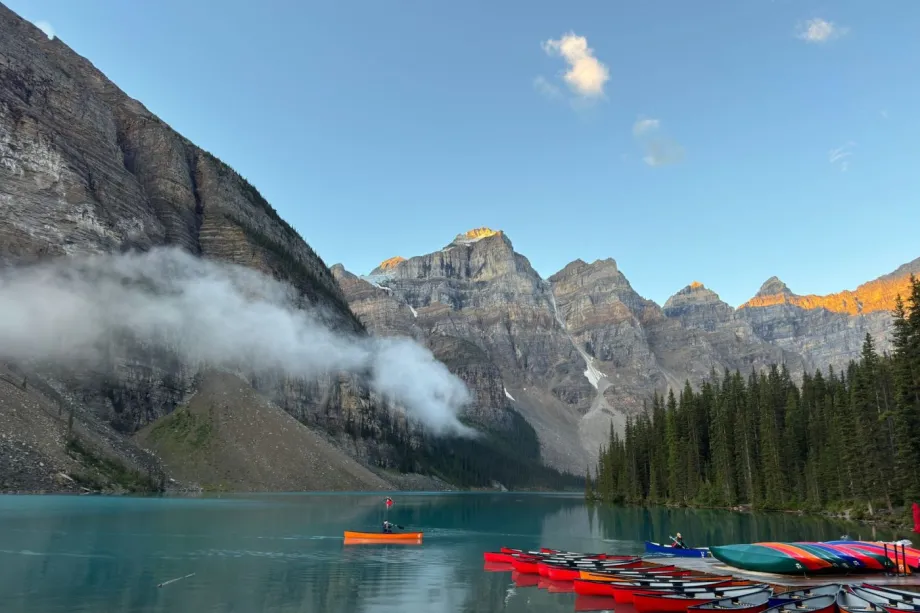
After your walk, drive twenty minutes up the winding road to Moraine Lake. The road is open from late May to mid-October; personal vehicles are restricted during peak hours. Parks Canada shuttles run regularly from the Lake Louise Park and Ride when the road is closed to private cars. At Moraine Lake, climb the short Rockpile Trail for the classic view of the Valley of the Ten Peaks reflected in the water.
For lunch, the Lake Louise village has several casual spots including a bakery and a well-stocked market. The Fairmont Chateau Lake Louise also serves lunch in the Lakeview Lounge, where you eat with the lake right outside the window. Book a table a day ahead if you want to sit down at the Fairmont.
Day 3: Sulphur Mountain and the Bow Valley Parkway
Start your morning with a ride up the Banff Gondola to the summit of Sulphur Mountain. The eight-minute journey lifts you to 2,281 metres, where the main observation deck looks straight down the length of Banff Avenue and across six mountain ranges. Walk the fully accessible boardwalk along the ridge to Sanson’s Peak, a one-kilometre route that takes about 30 minutes each way and ends at the historic stone weather station.
After coming back down, drive east out of town and turn onto the Bow Valley Parkway, the slower road that parallels the Trans-Canada Highway between Banff and Lake Louise. The 50-kilometre route follows the Bow River and passes through quiet forest with frequent wildlife sightings early and late in the day. Pull over at Johnston Canyon and walk the steel catwalks bolted to the limestone walls to reach the Lower Falls, a 1.2-kilometre trail that brings you within arm’s reach of the water. If time allows, continue another 1.5 kilometres to the Upper Falls, where the cascade drops 30 metres into a deep pool.
Where should you stay during a 3-day Banff trip?
Your base shapes how much you walk and how much you drive. Staying in downtown Banff puts restaurants, shops and the Bow River trail seconds from your door, but you trade quiet for convenience. A lodge outside the core gives you a quieter night and mountain views right from the window, with a short drive to the main trailheads.
For a three-day trip, a location along Banff Avenue or on Tunnel Mountain Road works well. You want a place where you can park once and walk to dinner, then reach the Trans-Canada Highway in under five minutes for your day trips to Lake Louise and the Bow Valley Parkway. Look for a lodge that offers a hot breakfast so you can leave early without an extra stop.
What to check before booking:
- Free parking on site, not a public lot a block away.
- An outdoor hot tub or a fireplace lounge for evenings after long hikes.
- A room with a view of Cascade Mountain or Mount Rundle, not the parking lot.
- Walking distance to at least two restaurants and a coffee shop.
- Soundproofing mentioned in recent guest reviews. Train noise is real near the railway tracks.
What should you pack for 3 days in Banff?
Mountain weather shifts quickly, so packing a few flexible layers works better than bringing a single heavy coat. A waterproof shell jacket is the one item you should not skip, even on a sunny forecast. Underneath, a fleece or a lightweight insulated jacket lets you adjust as you warm up on a hike or cool down at a viewpoint.
Sturdy footwear matters more than fashion. Waterproof hiking shoes or trail runners with good tread handle both paved paths and dirt trails around Lake Louise. Bring a reusable water bottle to fill at taps in town and at trailheads, and carry bear spray in an accessible spot, not buried in your pack.
- A waterproof and windproof outer shell jacket.
- One fleece or lightweight insulated midlayer.
- Waterproof hiking shoes or boots with solid tread.
- A reusable water bottle, at least one litre.
- Bear spray carried in a belt holster or side pocket.
- Sunglasses, sunscreen and a brimmed hat for high-altitude sun.
Frequently asked questions
Do I need a park pass for a 3-day visit?
Yes. A Parks Canada pass is required for all visitors stopping in Banff National Park. You can buy a day pass at the park gates or order one online before you arrive.
Can I visit both Lake Louise and Moraine Lake in one day?
You can, if you start early. Parking fills up fast, so many visitors take the Parks Canada shuttle or a private shuttle from the Lake Louise Park and Ride lot. Plan your shuttle tickets ahead of time in summer.
Is it better to rent a car or use shuttles for this itinerary?
A rental car gives you the most flexibility, especially for the Bow Valley Parkway drive. Shuttles work well for Lake Louise and Moraine Lake, but having your own vehicle makes reaching trailheads and viewpoints easier.
Are restaurants in Banff walkable from most hotels?
Most restaurants in downtown Banff are within a short walk of the main hotels and lodges. If you stay outside the town centre, you may need to drive or use a local taxi for dinner.