
Banff Winter Activities for Non-Skiers
Banff in winter offers far more than downhill runs. You can skate on a frozen lake, walk through a snow-filled canyon, soak in hot springs with a mountain view, and join a festival that lights up the whole town.
Where can I ice skate outdoors in Banff?
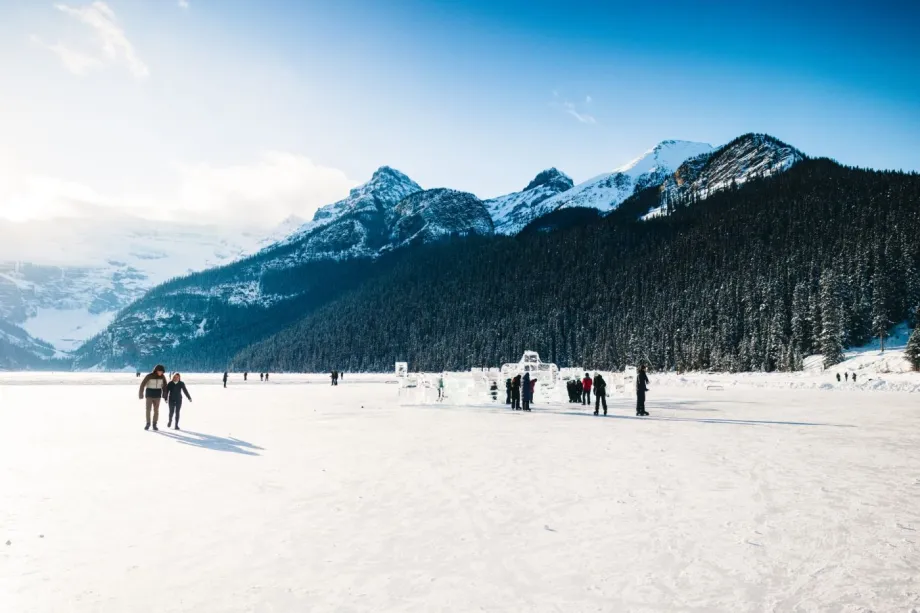
The cleared rink on Lake Louise is the most scenic outdoor skating in the park, with Victoria Glacier as a backdrop. Parks Canada maintains it daily from roughly mid-December to mid-April, conditions permitting. A boarded outdoor rink at the corner of Squirrel Street and Elk Street is lit for evening use and free to the public.
The Fairmont Banff Springs clears a small pond behind the hotel for guests and visitors, framed by the main building's stone architecture. Skate rentals are available at the Fairmont's equipment shop and at Wilson Mountain Sports in Lake Louise village. You can also hire skates at Ultimate Sports in downtown Banff on Bear Street.
- The Lake Louise rink is cleared on the lake near the Fairmont Chateau and is open to anyone who brings skates.
- The Banff Community High School rink has boards, lights and a bench area for changing footwear.
- The pond at the Fairmont Banff Springs is smaller and free to use, with rentals steps away inside the hotel.
- Wilson Mountain Sports in Samson Mall rents hockey and figure skates by the half-day.
- Ultimate Sports on Bear Street carries a range of sizes and also rents helmets.
- All three rinks are free to enter; you pay only for parking at Lake Louise and for rentals.
What snowshoe trails suit a beginner?
Several flat, well-marked trails near Banff and Lake Louise let you try snowshoeing without tackling steep climbs. The Fenland Trail is a 2 km loop just outside Banff town that follows a quiet creek through spruce forest and takes about an hour. The 4 km Shoreline Trail at Lake Louise runs along the frozen lake edge with clear views of the Victoria Glacier and no elevation gain.
You can rent snowshoes and poles in Banff at Snowtips-Bactrax on Bear Street or at Wilson Mountain Sports in Lake Louise village. Both shops offer half-day and full-day rates and adjust the bindings to your winter boots. Guided group tours run daily in the national park and include transport, gear and a leader who picks a route matched to the group's pace.
- Fenland Trail in Banff: a level 2 km loop sheltered by trees, starting near the train station.
- Lake Louise Shoreline: a wide 4 km out-and-back track on packed snow with mountain views.
- Bow River Loop in Lake Louise village: a short, flat circuit beside the river, well signed and easy to follow.
- Johnston Canyon catwalk: a narrow 2.7 km trail with handrails, open to snowshoers when ice cleats are not enough.
- Rentals at Snowtips-Bactrax in Banff or Wilson Mountain Sports in Lake Louise include poles and a quick fitting.
- Guided tours run by Discover Banff Tours and White Mountain Adventures cover transport, gear and route selection.
Which winter festivals happen in Banff?
Banff and Lake Louise run two cold-weather festivals that fill the calendar from mid-January into early February. SnowDays takes over downtown Banff with large snow sculptures along Bear Street, a skijoring demonstration on Banff Avenue where a horse pulls a skier over jumps, and free live music in the evenings. The event typically runs for two weeks and is easy to reach on foot from most in-town lodging.
The Ice Magic Festival takes place at the Fairmont Chateau Lake Louise during the last two weekends of January. Professional ice carvers from several countries carve massive blocks of ice, turning the lakeshore into a gallery of detailed sculptures. Visitors watch the carving in progress during the day, and the finished pieces are lit after dark. A skating rink on the lake stays open throughout the festival, and you can buy hot chocolate beside it.
What indoor experiences work on a cold day?
Several indoor stops in Banff make a frigid afternoon feel like a feature, not a setback. At the Banff Upper Hot Springs, you can soak in 38-40°C mineral water with views of Mount Rundle through the steam. You can rent a swimsuit and towel on site if you did not pack them. The Whyte Museum of the Canadian Rockies has a permanent collection of mountain art, early Banff photography and a restored heritage home that shows how people lived here before heated hotel lobbies.
- The Cave and Basin National Historic Site combines the original sulphur spring that started it all with an indoor interpretive centre and short film about Banff’s park origins.
- Fairmont Banff Springs offers a day spa with a mineral pool, sauna and steam rooms open to outside guests, plus a quiet lounge where you can read by a fireplace.
- Wild Flour Bakery on Bear Street bakes pastries all day and the upstairs seating stays calm even when the street is busy.
- Whitebark Cafe inside the Banff Aspen Lodge pours espresso and hot chocolate with a small, warm room that works for an hour with a book.
- Willow Stream Spa, also at the Fairmont, adds a eucalyptus steam room and a heated outdoor plunge pool that feels especially good when snow is falling.
A cold day also lines up well with a slow afternoon inside a few of Banff Avenue’s bookshops and galleries, where you can warm up without spending on an entry ticket. Combine two stops that sit within a few blocks of each other and you have a full, comfortable day that costs little more than a lift pass.
Can I walk on a frozen canyon near Banff?
Johnston Canyon offers a maintained trail that lets you walk between towering icefalls and frozen waterfalls without technical climbing. The catwalks built into the canyon wall stay open through winter, giving you a close look at the Upper and Lower Falls when they are solid pillars of blue ice.
Ice cleats that strap over your winter boots are essential, as the path is packed snow and polished ice in many sections. Hiking poles give you extra stability on the steeper parts of the catwalk stairs. Parks Canada does not require a guide if you stay on the marked trail, but several local operators run guided ice walks that include transport from Banff and all the traction gear.
Go in the morning to avoid the midday crowd and to see the clearest light on the frozen falls. The round trip to the Upper Falls takes about two hours at a steady walking pace, and the canyon is roughly 25 km west of Banff on the Bow Valley Parkway.
How do I get around without a car in winter?
Banff town is compact and walkable, so you can reach most shops, restaurants and the Bow River trail on foot even in snowy conditions. Sidewalks along Banff Avenue and the connecting streets are cleared regularly, and many hotels are within a 10-minute walk of the downtown core.
For trips beyond the town boundary, Roam Public Transit runs winter routes that connect Banff to Lake Louise and Johnston Canyon. A separate weekend and holiday shuttle serves the Lake Minnewanka area from late December through early April.
- Route 8X (Banff, Lake Louise Express) runs daily and stops at the Lake Louise Lakeshore in winter, with several departures each morning and afternoon.
- Route 9 (Banff, Johnston Canyon) operates on weekends and holidays from November to April, with a morning departure and an afternoon return.
- Route 6 (Lake Minnewanka Shuttle) runs on weekends and holidays from late December to early April, leaving from the Banff High School transit hub.
- Banff AIrporter and private shuttles offer direct transfers from Calgary International Airport to Banff hotels, with multiple departures throughout the day.
- Taxi service is available year-round in town, and most hotels can call one for you if you plan a dinner or an evening activity away from your lodging.
Frequently asked questions
Is the Lake Louise skating rink free?
Yes. The cleared ice surface on Lake Louise is maintained daily and free to use. You can bring your own skates or rent a pair from the nearby Chateau Lake Louise. The rink is typically open from mid-December to mid-April, weather permitting.
Do I need a guide for snowshoeing?
No. Many marked trails around Banff are easy to follow on your own. If you are new to the activity or want to learn about the landscape, Parks Canada and local outfitters run guided snowshoe tours that include equipment.
What should I wear for a winter walk in Banff?
Dress in layers you can adjust. A moisture-wicking base layer, an insulating mid-layer and a windproof outer shell work well. Insulated boots with good tread are essential, and ice cleats help on packed trails.
Are the Banff Upper Hot Springs open in winter?
Yes. The outdoor pool stays open year-round, and winter is one of the most popular times to visit. Steam rises off the 38-40 °C water while you look out at snow-covered peaks. Towels and swimsuits can be rented on site.